

Martech SaaS Series: How to Build a 4DX Execution System for SaaS Growth
Turn revenue targets into an operational system by defining a WIG, mapping lead measures, and translating them into weekly execution tied directly to pipeline, activation, and expansion

Welcome to my Martech SaaS Series where I break down how I engage with martech companies to drive pipeline, positioning, and enterprise growth.
This third post is different. Instead of a case study, I’m going to show you the exact methodology I use to create GTM plans from scratch inside companies like Polymail and Bupple.
This is taken from what’s called “4DX” — The 4 Disciplines of Execution, a framework developed by Chris McChesney, Sean Covey, and Jim Huling — applied here to SaaS GTM.
Most SaaS teams simply lack a system that connects day-to-day execution to financial outcomes. 4DX provides that system.
What 4DX Actually Is (in SaaS terms)
4DX is a system for forcing focus and translating strategy into execution.
In practice, it does one thing really well:
It takes “we want to grow” and turns it into a measurable, trackable, operator-run system tied directly to revenue.
You define:
One core outcome (WIG)
A small set of lead measures
A clear execution map
A cadence of accountability
That’s it. Here’s how it works:
1. Define the WIG (Wildly Important Goal)
The WIG is the single revenue outcome that anchors all execution.
It must meet three criteria:
Quantitative (clear numeric target)
Time-bound (fixed deadline)
Revenue-linked (MRR or ARR)
Examples:
Grow Polymail from ~$27K MRR to $84K MRR by 2026
Grow Bupple to $3M ARR by EOY 2026
The WIG is the constraint. It determines prioritization across all teams. Any initiative that does not contribute to this outcome is deprioritized.
2. Establish Lead Measure Buckets
Lag measure = revenue (MRR / ARR)
Lead measures = controllable inputs that drive the lag measure
Lead measures are grouped into a small number of buckets that represent the growth system.
A standard structure:
1. Audience Growth (Top of Funnel)
Impressions
Content reach
Creator interactions
2. Demand Capture
Trials or signups
Conversion from visitor to trial
Cost per acquisition
3. Expansion & Usage
Trial-to-paid conversion
Activation rate
ARPU growth
4. Network Effects
Referral rate
K-factor
User-generated distribution
Example targets (from Bupple system):
50M+ impressions/month
~5,500 net new trials/month
22% trial-to-paid conversion
K-factor of 0.40
Each lead measure must be:
Quantifiable
Trackable weekly
Directly tied to revenue progression
3. Map Systems to Each Lead Measure
Each lead measure bucket is supported by a defined set of systems. These systems represent repeatable growth mechanisms, not one-off campaigns.
Audience Growth Systems
Owned media property (e.g., content hub or brand)
Creator or influencer network
Platform-native content distribution
Demand Capture Systems
Product-led growth (PLG) trial funnel
Founder-led or AE outbound motion
Website conversion infrastructure
Expansion & Usage Systems
Onboarding flows and lifecycle sequences
Product nudges and feature activation
Community or education layer
Network Effect Systems
Referral programs
Templates, assets, or shareable outputs
Marketplace or ecosystem expansion
Each system must be explicitly tied to one or more lead measures. Systems without measurable output are removed.
4. Translate Systems into Execution Tasks
Systems are decomposed into concrete, repeatable tasks. This step converts planning into execution.
Examples:
Audience Growth
Recruit 10–15 creators per week producing tagged content
Publish 7–10 short-form videos per week across platforms
Execute weekly distribution in targeted communities
Demand Capture
Launch and optimize paid acquisition campaigns (e.g., search, social)
Run structured outbound sequences with defined daily volume
Deploy conversion-focused landing pages and templates
Expansion & Usage
Implement milestone-based onboarding sequences (days 1, 3, 7, 14)
Introduce in-product prompts tied to usage thresholds
Launch community spaces for activation and retention
Network Effects
Deploy referral incentives tied to user actions
Build and distribute templates for user reuse
Enable sharing mechanisms within product workflows
Tasks must be:
Specific
Repeatable
Owned by a defined individual or function
5. Build a Weekly Cadence
Execution requires a consistent measurement and accountability loop.
A standard cadence includes:
Weekly tracking of all lead measures
Ownership assigned per system and metric
A visible scoreboard (dashboard or sheet)
Metrics tracked weekly:
New trials or signups
Activation rate
Trial-to-paid conversion
Content output and reach
Referral activity
The purpose of cadence is to ensure that:
Lead measures are improving week over week
Systems are producing expected outputs
Execution gaps are identified immediately
Without weekly tracking, lead measures degrade and systems lose effectiveness.
6. Align the System to Revenue Progression
The final step is ensuring that lead measures scale proportionally with the WIG.
Example:
Required MRR growth determines required number of new customers
Required customers determine required trials
Required trials determine required traffic and reach
This creates a reverse-engineered model:
Revenue target → conversion rates → required inputs
Each lead measure is then calibrated to meet that requirement.
In Practice: Bupple — 4DX Applied to Full-Funnel Growth
I partnered with Bupple, a pre-revenue AI content studio taking on VEED and Descript in 2025, to design a full-funnel growth system from first principles. The objective was to take a zero-base starting point and map the exact inputs required to reach $3M ARR within a defined timeline. The approach was to eliminate ambiguity by defining the entire growth engine upfront—what drives users, what converts them, and what expands revenue.
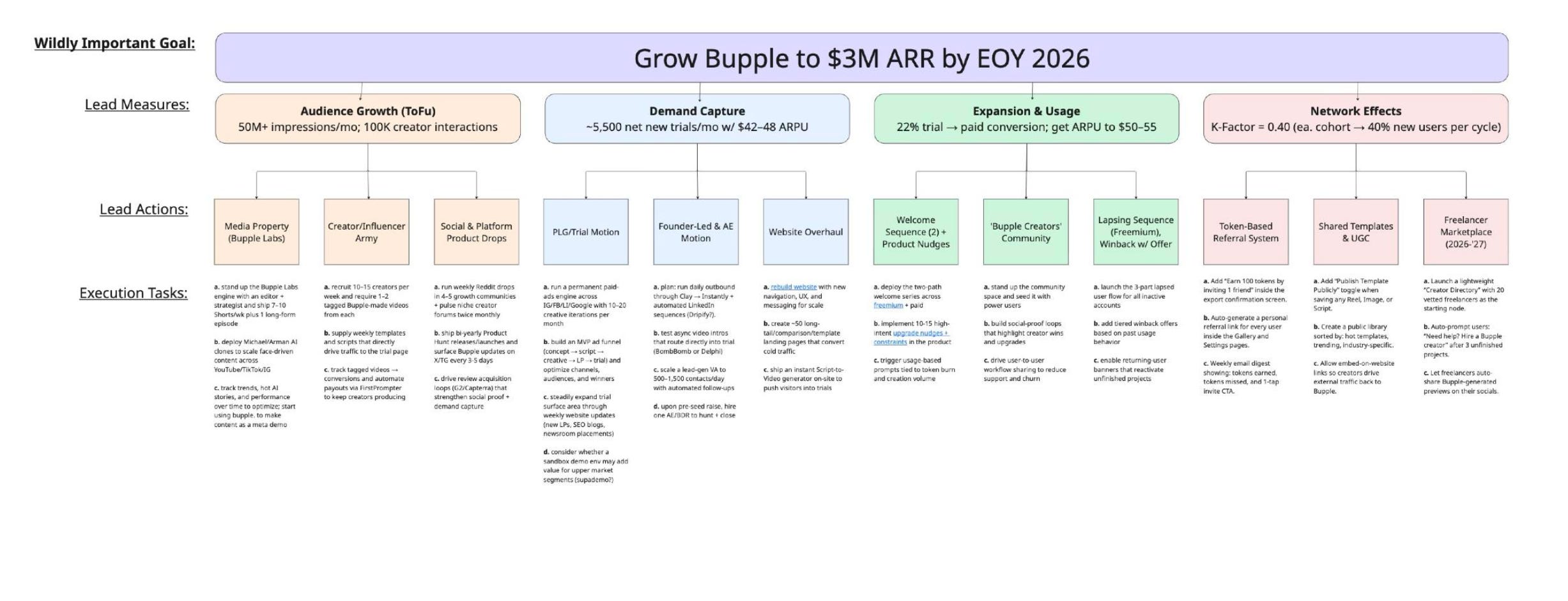
The system breaks growth into four measurable layers—audience creation, demand capture, expansion, and network effects—each reverse-engineered from a $3M ARR target and assigned explicit numeric inputs: ~50M monthly impressions, ~5,500 trials at $42–48 ARPU, 22% trial-to-paid with expansion to $50–55 ARPU, and a 0.40 K-factor. Every initiative across content, outbound, product, and lifecycle ties directly to one of these inputs, eliminating disconnected work. Execution is managed against weekly performance of these metrics, ensuring progress toward ARR is driven by controlled, repeatable actions.
Key Principles
Limit focus to one WIG
Use a small number of lead measure buckets (3–5 maximum)
Tie every system to a measurable output
Decompose systems into weekly execution tasks
Track performance weekly without exception
Where Judgment Actually Matters
Judgment is not evenly distributed across this system. Defining the WIG requires some judgment, but it is largely constrained by revenue targets and timelines. Establishing lead measure buckets is more nuanced, but still follows common patterns across SaaS (acquisition, conversion, expansion, referrals). The numbers themselves are math-driven once conversion rates and targets are known. The highest-leverage judgment sits lower in the system—choosing which growth systems to deploy and how to translate them into execution tasks that actually perform in a specific market, with a specific product, at a specific stage.4DX is an execution constraint that forces alignment between strategy, operations, and revenue.
* * *
This system removes ambiguity from growth execution and replaces it with measurable inputs and outputs.
When implemented correctly, it creates a direct line between weekly activity and revenue outcomes.
If this is something you want help with, I build and implement these GTM systems with teams directly — here’s how.